Candace Tabbs, Associate Director of Education, on how to approach arts education grant applications and build fruitful school partnerships.
When we think about Arts Education, many things come to mind such as in-school, after school, secondary, post secondary, college prep, education for adults, senior services. However, for arts funders “arts education” typically means K-12 in-school or after school programming.
If you have programming that serves these groups and want to fundraise for it effectively and sustainably, it is essential to consider the specificity of the arts education grants ecosystem in your strategy and application preparation. In this article, we decipher the key features of the process.
Assessing the Eligibility and Fit
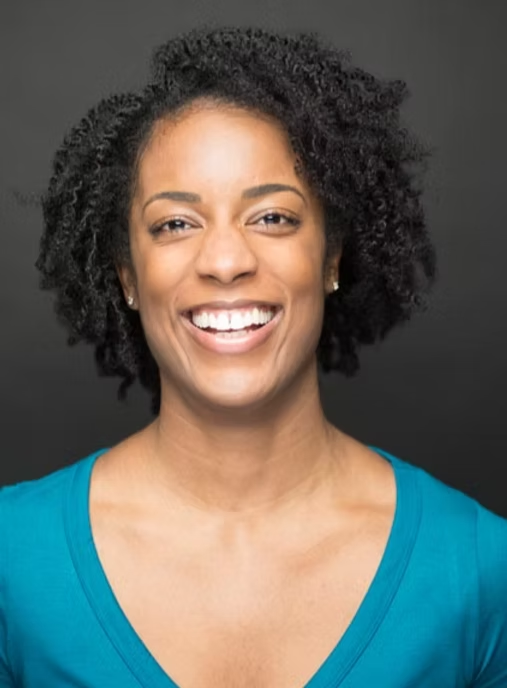
Candace Tabbs
Consultant & Associate Director of Education
Eligibility can seemingly be a trivial point that, nevertheless, might be not so obvious with education grants. While your organization and a program might pass the eligibility threshold by basic requirements, the depth and breadth of your program’s impact can play a decisive role.
For example, you’re a performing arts group that mainly produces shows and runs one after-school program a year with a particular school. In this case, it will be a harder sell for you than for an organization that mainly or solely provides arts education programs, because it fits more squarely into the definition of an arts education organization set by the funder’s guidelines. Assessing the guidelines and the funder’s profile with its priorities and interpretations is important to understanding what funders are looking for and if you are a fit for the opportunity.
Laying the Ground for a Successful Application: Relationship Building
The special feature of the arts education grants ecosystem is that funding is bidirectional: there are opportunities available for both arts organizations and the schools they work with. Establishing and maintaining a relationship with your schools is a cornerstone of efficient application processes, long-term partnerships, and sustainable funding.
For example, some foundation grants offer opportunities for organizations to address barriers to music education and enrichment. The NAMM Foundation invites arts education nonprofits to share how their programs make lasting effects on the growth and well-being of students. This opportunity is also applicable to out-of-school programs, such as mentorship and musician development programs. Save The Music Foundation partners with school districts and local communities to support Pre-K through Grade 12 school music programs with teachers, instruments and resources. While applications are by invitation only, school districts are welcome to share an expression of interest.
What makes NAMM and Save The Music great if you are a fit? They are invested in both starting and sustaining music programs.
Want to learn about more arts education funding opportunities? Sign up to our Monthly Brew newsletter, and we’ll send you our arts education grants list with the key information on each funder!
Another example of a school partner funding opportunity is the New York City Department of Education’s Arts Funding Program. It offers various grants, including the Arts Accelerator Program, Arts for Diverse Learners and Arts for Early Learners. Schools apply to bring in an organization to expand arts learning at their school through materials, equipment, and instructional spaces, inclusive arts education for multilingual learners and students with disabilities, and provide arts instruction for students in 3K, Pre-K, and Kindergarten, respectively.
What makes the Arts Funding Program great if you are a fit? More than one school can apply to bring in the same organization. So if you have an annual program where you have a 15-week residency at three different schools, each of your schools can apply for a $10,000-$25,000 grant to bring your organization in, depending on the program.
Making the Most of a School Partnership
Have strategic conversations with school leadership throughout the year about future collaboration. Don’t let attendance and program outcome data collection at the end of the school year be the only time you interface with school leadership. Below are some actions to consider throughout the year:
- February. Start preparing for the end-of-school-year evaluations.
- May. Have the conversations about offering programs for the next school year.
- June. Conduct and collect your evaluations. This can include attendance records, feedback surveys from students, teachers and caregivers, reflections from school leadership, measurements and outcomes as defined by the school district. When assessing school or statewide outcomes, be in conversation with school leadership on their rubric and formatting to ensure you provide the most accurate and complete evaluations.
- August. As teachers are building and solidifying their curriculum, talk to them about how your offerings can work in tandem with their plans. While some arts education programs are stand-alone offerings, others are facilitated inside an academic subject. Creating a program or artistic experience that supplements a classroom teacher’s curriculum can deepen student learning and engagement.
- October. Start having conversations about winter concerts, exhibitions and other holiday events you can collaborate on.
Must-Dos During the Program Delivery to Support Next Year Applications
Now that you’ve applied for and received funding to bring meaningful arts education programming to your communities, there are a few best practices to keep in mind:
- Have clear stats and measurements of outcomes. Do you have to meet specific criteria and standards for the instruction you provide? Make sure to have adequate channels to support collecting and analyzing that data. For example, ETM-Colorado demonstrates how they meet music education standards with their students with the help of a data evaluation service, using Metis Associates to collect data over a three-year period (2021-2024). This provides demonstrable third-party data to evaluate the effectiveness of the program. Investing in capacity and time to collect that data is really important because it allows you to get those repeat funders from both the government and foundations.
- Document your lessons and lesson plans. Whether a standards rubric, a spreadsheet with action items and deliverables or an outline and explanation of each class’s topics, lesson plan documentation will allow you to not only repeat your offering with ease but also provide a look into the experience your program offers to students that can be pitched to new partners.
- Document the experience. Work with teachers and school leadership to ensure you have the necessary release forms to capture students in action. Whether photo or video, a look into the experience you provide will demonstrate the importance of your work. Are you trying to get a new arts education program off the ground, but do not yet have documentation? Consider creating a vision board or concept guide that outlines the feel of the experience, materials you will use and how students will be guided through your offering. If you don’t already do so, consider organizing this information along with program attendance and other general metrics in a spreadsheet like this one. In arts education grant applications, there is a bit more space to submit teasers or bites of performances interspersed with interviews of students and teachers than in other disciplines. If you are juggling both running the program and documenting, even short clips can be useful.
Final Thoughts
As you continue delivering meaningful programs to the schools in your community, maintain and sustain your relationships. As you explore funding opportunities, build relationships with funders by reaching out with specific questions about guidelines and eligibility requirements or attend a grant application webinar to gain more insight. And fostering partnership and collaboration with schools, both in fundraising and programming, will support your sustainability and impact.