It’s been 14 years since the first Giving Tuesday in 2012. While this day has helped familiarize many people with the importance of philanthropic giving, it has also added so much noise to our inboxes and social media that many wonder if it’s even worth spending time creating posts and sending out asks.
While each organization has to make their own decision on whether Giving Tuesday is worth it for them, we have learned a lot at Benvenuti Arts about what makes the day worthwhile. In this article, we will discuss where Giving Tuesday came from, how to make the most of the day, and when it might be better to opt out.
What Is Giving Tuesday?

Sarah Benvenuti, Founder & CEO at Benvenuti Arts
Giving Tuesday was started in 2012 as a way to “encourage people to do good.” It took the idea of “Black Friday” and turned the focus from consumerism to philanthropy. As online giving was becoming more popular and trusted, Giving Tuesday made the most of the connected world we live in by helping nonprofits amplify their messages in email and social media to reach more people and generate more donations in one day.
While Giving Tuesday was born at the 92nd Street Y – a cultural and community center in New York City – it’s now an independent nonprofit with offshoots around the world.
While many people will tell you you must have something up on Giving Tuesday, simply making a post or an email send-out will not get you far.
Why Participate in Giving Tuesday?
For a lot of nonprofits, organizing donor campaigns can be stressful. Finding a theme, planning out all of your communications, figuring out how to get people’s attention: it can all be too much when added to the list of other myriad responsibilities that are on your plate when you are running a small organization.
Giving Tuesday can provide a framework that helps to alleviate some of that stress. A lot of your audiences know about the day; they may actually be looking for communications from their favorite organizations in order to drive their giving. So making yourself easy to find that day can be important.
Additionally, the Giving Tuesday website provides resources on how to craft your campaigns and many communities have opportunities to amplify your message to a broader audience.
Why Shouldn’t You Participate?
Even with all of the support that Giving Tuesday can provide, it is still incredibly difficult to rise above the noise. I don’t know about you, but my inbox on Giving Tuesday is a disaster, with dozens of emails from just as many nonprofits. Additionally, while social media was once a good place to get attention on that day, the ever-changing algorithms have made it near impossible to get in front of the people who actually want to give (and this is a conversation worthy of a separate article).
While many people will tell you that you must have something up on Giving Tuesday, simply making a post or an email is not going to get you far. You still have to plan, prepare your community, and put in the hours to make Giving Tuesday worth it. If you’re going to do all that work anyway, why not do a full campaign to activate your supporters at a time of year when there is less competition?
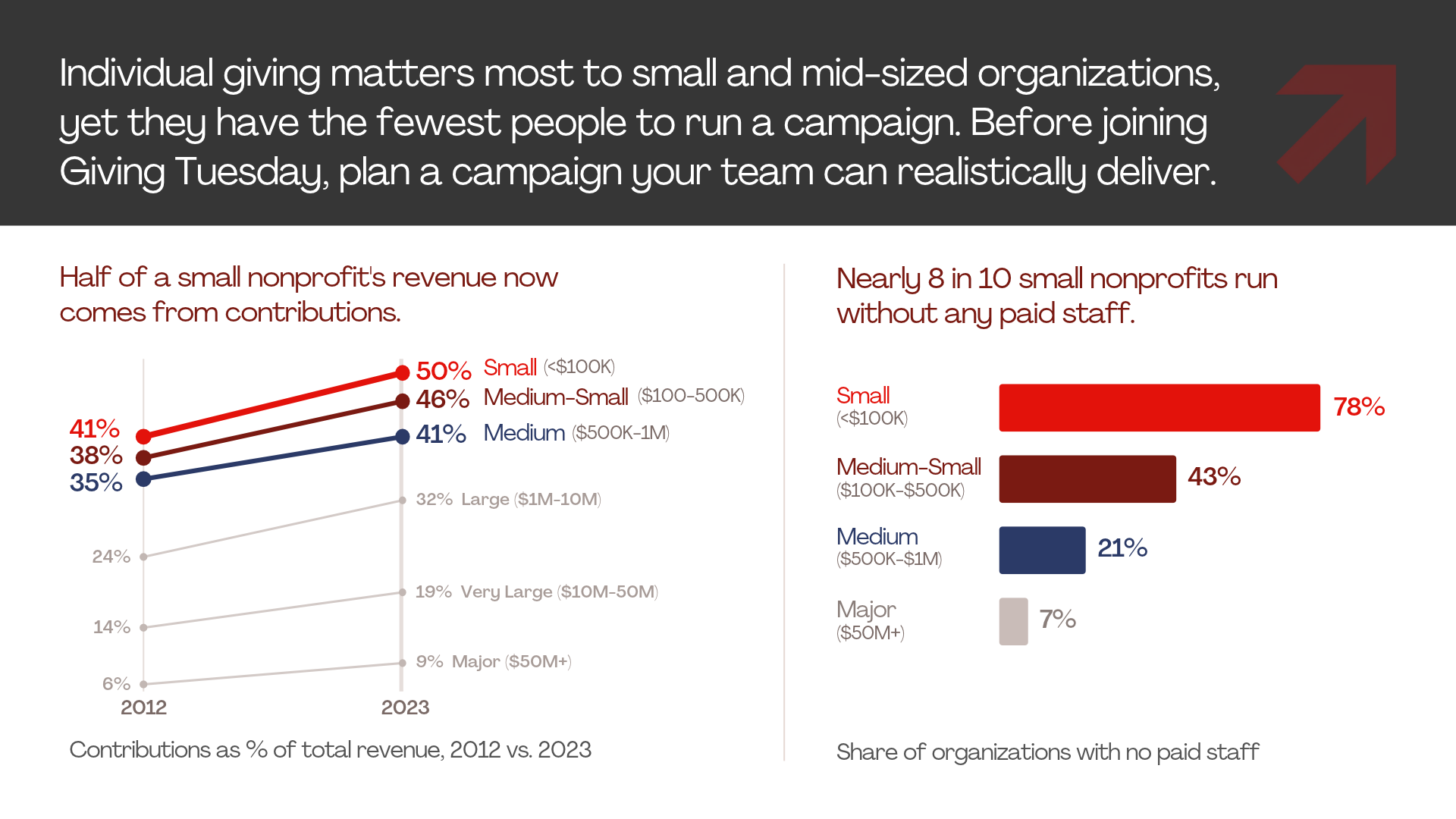
Data: GivingTuesday, Mapping the Giving Ecosystem: What Public Data Can, and Cannot, Tell Us About the Social Sector (2026), Fig. 3.2 “Contributions as Percent of Total Revenue” and Fig. 3.9 “Salaries as a Percent of Total Expenses.” – https://nonprofitecosystem.givingtuesday.org/2026report/. Graphics by Benvenuti Arts.
If I Opt Out of Giving Tuesday, What Am I Supposed To Do?
Our advice around crafting any campaign is pretty much the same, no matter when you plan to implement it. Unless you have a few major donors who can quickly write you checks, the path to a successful individual fundraising effort is filled with careful preparation and thoughtful partner engagement.
1. Plan early! We know this is sometimes easier said than done, but if we had to pick one piece of advice for creating an effective fundraising campaign, this would be it. Some groups will come to us in October wanting to plan a campaign for November. Unless you have all of your time to spend on the campaign, this is too late. Look three to four months ahead so you can plan your publication calendar, prepare your community to amplify your message, craft your language and content, and leave plenty of time for individualized outreach to ensure you reach your donors.
2. Find useful tools. In addition to the Giving Tuesday website, many communities – like Colorado – run their own special giving days with many tools for nonprofits. Donation platforms like Givebutter and Give Lively provide ample tools for activating your community around fundraising efforts. Check these out months before your campaign so that you have time to take advantage of the advice they provide.
3. Activate your community. Many organizations will just send a series of emails from their email platform, but these will most probably get lost in donors’ inboxes or pushed to a promotions folder. You are more likely to actually reach people if your Board, artists, and other supporters help to spread the word. An email coming from a friend or a text from a beloved artist will engage a potential donor much better than an impersonal, mass e-blast.
4. Try snail mail! At a time when most of us only get junk in our physical mailboxes, a personalized piece of mail can really make an impact. Especially if you can coordinate handwritten notes or a nice-looking mailer, physical mail stands out and reminds people of how much they love your organization.
One last pitch: If you decide not to plan your campaign around Giving Tuesday, consider amplifying your partners’ messages that day instead. IndieSpace, an organization that provides funding, real estate services, and advocacy to the theatre industry in New York City, does this. They reshare indie theaters’ campaigns across the city instead of running their own. When it comes to fundraising, the rising tide truly does lift all ships, as more donors mean more support for the art in our communities.
Need help planning your campaign? We can help! Book a free 30-minute consultation.